
SKILLS INTELLIGENCE
The Skills Layer that Powers Every Talent Decision Across Your
HR Ecosystem

WORKFORCE AGILITY
Replace Workforce Planning Assumptions with a Live Skills Inventory
You cannot plan a workforce you cannot see. Many organizations still rely on job titles, org charts, and static spreadsheets to make headcount and capability decisions. Fuel50’s skills intelligence platform gives HR, finance, and business leaders a live, granular view of skills supply and demand across the enterprise, so workforce planning is grounded in evidence, not assumptions.

Skills Ontology
More than 5,000 skills with proficiency levels, development actions, and market trend data, curated and maintained by People Scientists. A governed foundation designed to make downstream talent decisions more reliable.

Skills Architecture
Maps skills to roles, job families, and functions at scale, creating a structured, skills‐centric job architecture that connects the work that needs to be done with the skills required to do it across your HR ecosystem.

Insights
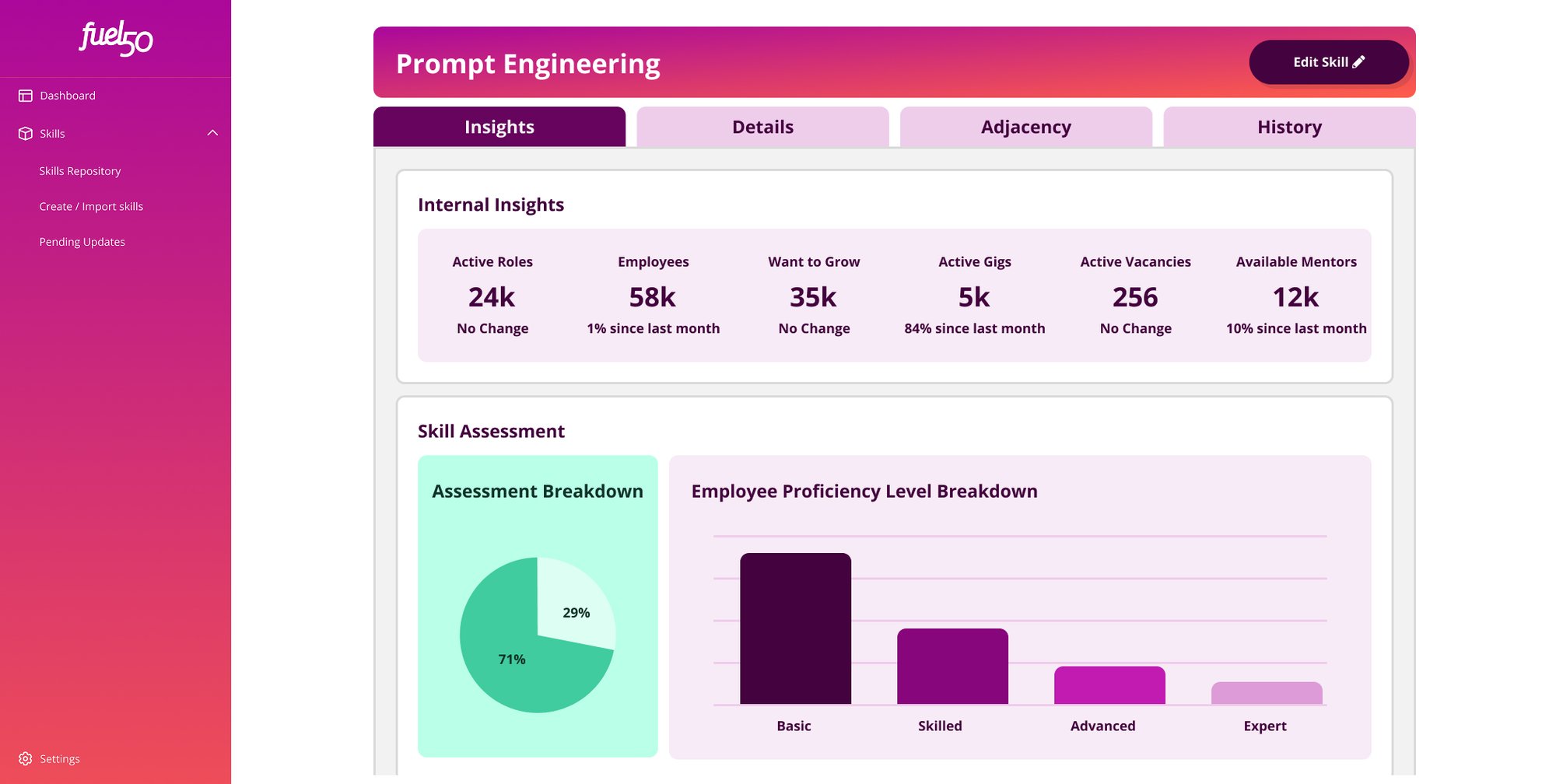
Real‐time skills analytics that show what skills you have, where they sit, how they are trending, and where gaps are emerging by team, function, location, or level. Benchmark internally and against external market data so you invest where it matters most.

SKILLS VISIBILITY & MANAGEMENT
Become Skills-Based — Without Sacrificing Speed, Quality, or Control
Many enterprises want to move from job‐based to skills‐based operating models but stall because the underlying skills data is noisy or incomplete. AI‐only approaches can create duplication and skills labels people don't trust. Manual approaches don't scale. Fuel50’s skills intelligence platform combines expert human curation with AI amplification to deliver a rigorous, tailored skills foundation that keeps pace with your transformation agenda.
Skills Ontology
An expert‐driven skills ontology curated by People Scientists, validated by behavioral science methods, and updated with market signals. Designed to minimize duplicates and quality drift as your skills landscape evolves.
Skills Architecture
Connects your skills ontology to your job architecture with collaborative role‐profile reviews, AI‐assisted skill‐to‐role mapping, and proficiency‐level alignment, so each role is defined by the skills and outcomes it
actually requires.
Insights
Tracks the progress and impact of your skills transformation with usage analytics,
skill‐relevance monitoring, and adoption metrics. Shows which skills are growing, which are declining, and where transformation is taking hold or slowing down.

UNIFIED SKILLS LAYER
One Skills Language. Every System. Strong Governance.
Fragmented skills data undermines the value of your HR technology investments. When your HRIS, LMS, and ATS each use different skills taxonomies, recommendations and analytics lose credibility.
Fuel50’s Skills Intelligence platform acts as a unified skills layer across your HR ecosystem, providing a governed source of truth that feeds consistent, high‐quality skills data into every tool, workflow, and decision.
Skills Ontology
A structured, deduplicated skills taxonomy that serves as the shared language for skills across your organization. Configured to integrate with Workday, SAP SuccessFactors, learning systems, applicant tracking systems, and other tools that depend on clean skills data.
Skills Architecture
Governance workflows for managing skills updates, approvals, and modifications. AI‐assisted duplicate detection, change tracking, and collaborative review processes keep your skills data clean and auditable as your organization evolves.
Insights
Verifies skill relevance through usage analytics and alerts you when relevance declines. Adds job‐posting trends, projected skill growth, and salary benchmarks so your skills layer reflects current market conditions, not outdated assumptions.

Skills Management
Know What Skills the Market Demands Before You Commit Investment
Skills strategy cannot be built in a vacuum. HR and business leaders need to understand how their internal skills inventory compares to market demand, which skills are emerging, and where investment will have the greatest impact. Fuel50’s skills intelligence platform provides market benchmarking and competitive skills insight so your investments are forward‐looking and defensible.
Skills Ontology
Enriched with external labour‐market data so you can see which skills are rising, holding steady, or declining in demand across industries and regions, and where your current skills portfolio may be at risk.

Skills Inventory
Benchmarks your role‐to‐skill mappings against external data, helping you identify roles that may be under‐skilled or over‐specified relative to the talent market and adjust profiles accordingly.
Insights
Dashboards that show job‐posting volume, roles featuring specific skills, projected growth rates, and indicative salary ranges for skills in your ontology. Supports skills investment decisions you can explain to the board and finance.

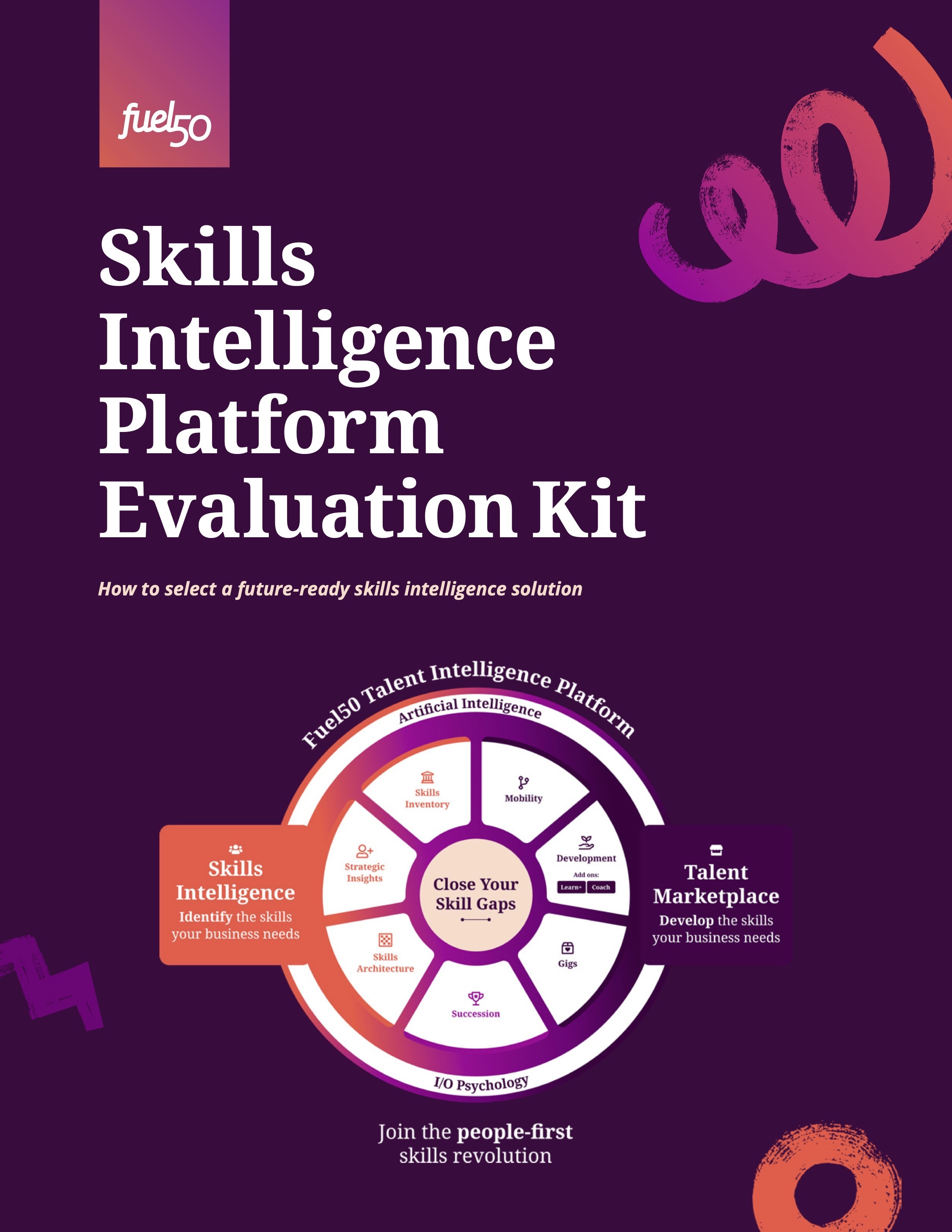
You can’t close skills gaps if your platform can’t see, explain, or act on them.
Success Stories
Fuel50 partners with many organizations that are moving toward skills‐based ways of working, including Sage, KeyBank, Electronic Arts, and others. These customers report cleaner skills data, better workforce‐planning decisions, and faster progress toward skills‐based operating models.




FAQs
What is a skills intelligence platform and how is it different from a skills ontology?

A skills ontology defines skills and their relationships. Skills architecture connects those skills to jobs and structures. A skills intelligence platform brings these layers together, analyzing and benchmarking skills data across the organization so leaders can make workforce decisions based on evidence rather than static
job descriptions.
How does Fuel50 act as the skills layer across our HR tech stack?
Fuel50’s skills intelligence platform provides a single, governed skills taxonomy that can feed consistent data into Workday, SAP SuccessFactors, learning systems, recruiting tools, and analytics platforms. This reduces duplication and conflicting skills lists, and gives every system access to the same underlying skills language.
How does Fuel50 support skills data quality and governance?
Fuel50 combines expert curation with AI‐supported workflows such as duplicate detection, approval flows, and change tracking. Skills are reviewed and updated over time using usage data and external market signals, so leaders can see how the ontology evolves and why changes are made.
Can Fuel50’s skills intelligence platform work alongside our existing Workday or SAP environment?
Yes. Fuel50 is designed to sit across existing HR technology, including Workday, SAP SuccessFactors, and other HRIS, ATS, and LMS systems. The platform connects via integrations and configuration work so the skills layer can be used by the tools you already rely on.
What outcomes can we expect from Fuel50’s skills intelligence platform?
Customers use Fuel50 to improve workforce‐planning accuracy, give leaders clearer visibility of skills and gaps, align learning investments with priority capabilities, and create a governed skills foundation that supports skills‐based hiring, internal mobility, and transformation initiatives.


Build the Skills Layer Your Entire
HR Ecosystem Depends On
Discover how Fuel50’s skills intelligence platform can give you a governed, expert‐curated source of truth for skills,
powering every talent decision, every system, and every workforce plan across your organization.